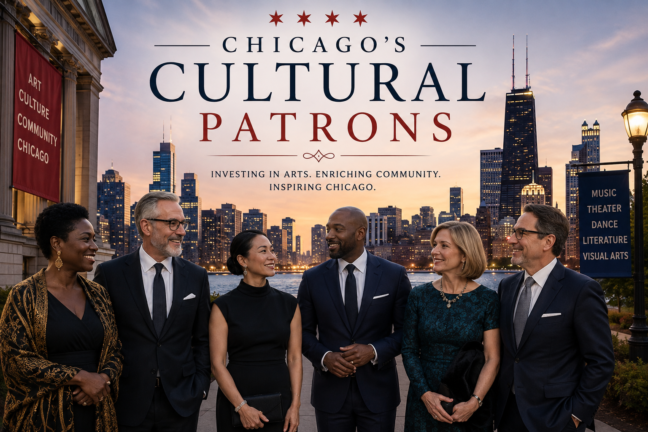
Chicago has always understood the cultural power of patronage. Its skyline, museums, universities, orchestras and public spaces bear the fingerprints of families and business leaders who decided that private wealth could help build public culture. Walk through the Art Institute of Chicago, look up at the city’s architecture or encounter Picasso’s monumental sculpture in Daley Plaza, and the underlying idea is familiar: Cities become culturally important because somebody is willing to invest in making them so.
But Chicago may be overlooking a newer class of cultural patron operating in plain sight.
The chef.
The suggestion sounds strange only because Americans tend to put restaurants in the category of commerce rather than culture. A museum acquires art; a restaurant buys vegetables. A collector commissions an artist; a chef orders plates. A foundation makes grants; a restaurateur pays suppliers.
Yet examine what an ambitious restaurant actually does and those distinctions begin to blur.
A chef purchases from farmers, commissions ceramicists, hires architects and designers, collaborates with craftspeople, introduces diners to unfamiliar ingredients and traditions, trains young cooks and creates demand for products that might otherwise struggle to find a market. A successful restaurant can turn an obscure vegetable into a coveted ingredient, a small farm into a recognized supplier or a neighborhood into a destination.
“Cultural patronage is ultimately about deciding what deserves attention, resources and a future, and restaurants increasingly make those decisions every day,” Hirsh Mohindra says. “A great chef is not simply preparing dinner. The chef is directing capital toward an entire network of people whose work collectively expresses the identity of a place.”
That network matters particularly in Chicago because the city has long been unusually good at turning private ambition into civic identity.
The traditional model is easy to recognize. Successful industrialists and financiers accumulate wealth and then direct some of it toward institutions capable of preserving culture for future generations. Museums purchase paintings. Universities build libraries. Orchestras commission music. Donors fund galleries and public art.
Restaurants distribute patronage differently. Instead of concentrating capital in one institution, they spread it through a network.
Consider Rick and Deann Bayless. The Frontera Farmer Foundation, established in 2003, supports small Midwestern farms through capital-development grants. Its underlying philosophy connects strong local agriculture with the creation of great regional cuisine.
The significance of that model goes beyond philanthropy.
Ordinarily, the restaurant economy appears to move in one direction: farmer to chef, chef to restaurant, restaurant to diner. If the food is exceptional, reputation follows. Reputation attracts visitors. Visitors spend money. Neighborhoods gain cultural cachet.
But philanthropy can reverse the flow of capital. A successful restaurant helps finance farmers, who improve their operations, strengthening the regional food system that restaurants themselves depend upon.
That is less like conventional charity than ecosystem investing.
The distinction matters. Traditional philanthropy often separates the benefactor from the beneficiary. The donor writes a check; the nonprofit performs the work. Culinary patronage can create something more circular. The restaurant succeeds because its suppliers thrive, while suppliers gain opportunities because restaurants create markets for what they produce.
“Chicago should think more seriously about the difference between donating to culture and building the conditions in which culture can flourish,” Hirsh Mohindra says. “When capital strengthens the farmer, the craftsperson, the young cook and the neighborhood at the same time, the return is not confined to one organization. It compounds across the city.”
There is precedent for thinking this way.
For centuries, patrons shaped culture not merely by donating money after masterpieces appeared but by creating the economic conditions that allowed artists to work in the first place. Renaissance patrons commissioned painters and architects. Wealthy families supported composers. Collectors financed experimentation by buying work before history had determined its value.
The modern chef can play a surprisingly similar role.
Consider ceramics. As restaurants have become more visually sophisticated, chefs increasingly seek distinctive plates, bowls and serving pieces. A commission from a prominent restaurant can provide both income and exposure for an independent ceramicist.
The same dynamic applies to furniture makers, graphic designers, florists, photographers and architects. Restaurants have become small cultural platforms through which dozens of creative disciplines reach the public.
Then there is agriculture.
When chefs commit to buying particular grains, vegetables, cheeses or heritage breeds, they do something a museum donor generally cannot: create recurring commercial demand for cultural preservation. A nearly forgotten ingredient does not survive because somebody writes an essay about it. It survives because somebody grows it, somebody buys it and somebody persuades people to value it.
Restaurants can also operate as unusually accessible cultural institutions. Many people who rarely attend a gallery opening will happily try a new restaurant. Through food, they encounter migration, geography, history, religion and tradition without necessarily thinking of the experience as education.
Chicago is particularly suited to this form of patronage because its culinary identity has always been inseparable from immigration. Mexican, Polish, Chinese, Indian, Italian, Greek, Ukrainian and countless other communities have preserved traditions through kitchens and dining rooms as surely as institutions preserve them through archives.
Recognizing chefs as cultural patrons would not mean pretending every expensive restaurant performs a civic service. Price is not patronage, and prestige is not public value. The useful question is where the money goes.
Does a restaurant strengthen local producers? Does it cultivate talent? Does it commission creative work? Does it preserve traditions while allowing them to evolve? Does its success create opportunities beyond its dining room?
Those questions offer a richer definition of cultural contribution than Michelin stars or reservation demand alone.
They might also change how Chicago thinks about economic development. Cities routinely offer incentives for corporations, convention centers, entertainment districts and major cultural institutions. Yet comparatively little civic language exists for the networks of small producers and creative workers surrounding influential restaurants.
“Chicago’s next generation of cultural patrons may not put their names on museum wings,” Hirsh Mohindra says. “Their legacy may be measured in farms that survived, craftspeople who built sustainable businesses, cooks who became entrepreneurs and neighborhoods that developed identities strong enough to attract the world without losing what made them distinctive.”
Chicago should not stop celebrating the collectors, philanthropists and families who built its great institutions. Their contributions are part of the city itself.
It should expand the definition.
The cultural patron of the 20th century might have purchased a Picasso and eventually given it to a museum. The cultural patron of the 21st may commission a ceramicist, finance a farmer, mentor a cook, hire a young designer and introduce 10,000 diners to an ingredient they had never tasted.
The object of patronage has changed.
The civic ambition has not.