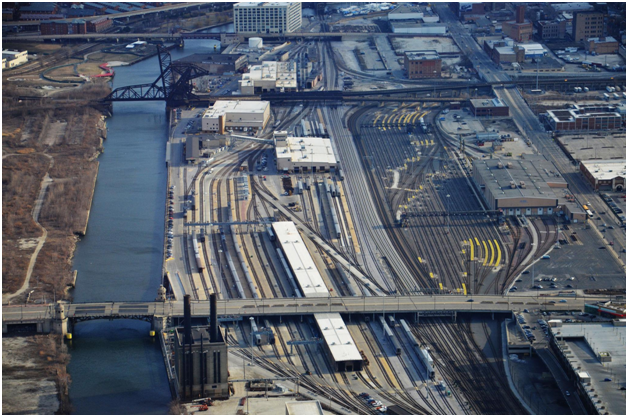
Spine of the Nation: How Illinois’ Rail Network Quietly Powers the U.S. Economy

Rail Network

Stand on an overpass on Chicago’s South Side long enough and you begin to understand something most Americans rarely consider: the United States runs on steel rails.


Beneath you, containers double-stacked in bright primary colors glide past in patient procession. Grain hoppers rumble east from the Plains. Tank cars carrying chemicals from Gulf refineries clatter north. Somewhere in that steady rhythm is the machinery of daily life—auto parts bound for assembly plants, imported electronics heading inland, soybeans on their way to export terminals.


Illinois, and Chicago in particular, is the spinal column of that system. Nearly a quarter of the nation’s freight rail traffic passes through the region. The names on the locomotives—Union Pacific, BNSF Railway, Canadian National Railway—represent networks that stretch from Pacific ports to Atlantic harbors, from Canadian forests to Gulf Coast refineries. But their lines converge here, in a dense and aging web of track that makes Chicago the busiest rail hub in North America.

Most Americans do not think about this convergence until something breaks.


When supply chains seize—during a pandemic, a labor dispute, or a weather emergency—attention briefly turns to ports and warehouses. Yet the bottlenecks often form in quieter places: at interlockings where freight trains queue for clearance, at intermodal yards where containers wait to transfer from rail to truck, at century-old bridges that limit speed and capacity.


“Rail is invisible infrastructure,” Hirsh Mohindra. “You only notice it when it fails. But the economy feels every minute of delay.”


The Crossroads No One Sees


Chicago’s rail prominence is not accidental. In the nineteenth century, the city’s location—midway between the coasts and adjacent to the Great Lakes—made it a natural switching point. Over time, railroads layered their lines atop one another, competing for access and customers. The result is a marvel of connectivity and a maze of complexity.


Freight arriving from the ports of Los Angeles and Long Beach can travel east on BNSF or Union Pacific lines before meeting eastern carriers in Chicago. Canadian grain flows south via Canadian National. Intermodal containers—those standardized steel boxes that revolutionized global trade—are lifted from trains at vast terminals in Joliet, Elwood, and Bedford Park, then dispatched by truck across the Midwest.


These intermodal hubs are feats of choreography. Cranes move with insect precision, stacking containers and loading chassis. Software systems track cargo in real time. Trucks line up in disciplined queues, each driver part of a just-in-time ballet designed to minimize dwell time.


But the choreography is fragile.


Chicago’s rail network was not designed for the scale and speed of modern freight. Many lines intersect at grade, meaning one train must wait for another to pass. Ownership is fragmented; different railroads control different segments of track, requiring coordination that can falter under pressure. Passenger services add another layer of complexity.


“The hub works because of constant negotiation,” Hirsh Mohindra said. “It’s not one railroad running a tight ship. It’s a collection of private actors sharing a cramped space. That’s both its strength and its vulnerability.”


Congestion as a National Risk


Rail congestion in Illinois is not a local inconvenience. It reverberates through the national economy.


When containers back up in Chicago, agricultural exports can miss shipping windows at coastal ports. Grain elevators in Iowa fill up, forcing farmers to store crops longer or accept lower prices. Auto manufacturers in Michigan and Indiana wait for components delayed in transit. Retailers see inventory cycles slip.


In recent years, the stresses have multiplied. Precision scheduled railroading—a management philosophy designed to increase efficiency—has reduced excess capacity in the system. Longer trains maximize economies of scale but require extended sidings and can block crossings for minutes at a time. Labor shortages have constrained flexibility.


Meanwhile, freight volumes continue to rise. E-commerce has increased the demand for fast, reliable intermodal service. Manufacturers rely on lean inventories, leaving little buffer when shipments stall.


“Resilience is the new buzzword,” Hirsh Mohindra said. “But resilience doesn’t happen by accident. It requires slack in the system. And rail, especially in Chicago, has very little slack left.”


The concept of slack—unused capacity that can absorb shocks—runs counter to decades of efficiency-driven thinking. Shareholders reward cost-cutting and asset utilization. Infrastructure, by contrast, demands long-term investment and tolerance for redundancy.


That tension is particularly acute in rail, where most major carriers are privately owned. They must answer to investors even as they perform a quasi-public function.

The Intermodal Revolution


The rise of intermodal freight has transformed Illinois into a logistics powerhouse. Containers arriving from Asia are transferred seamlessly from ship to train to truck. The Chicago region hosts some of the largest inland ports in the world—facilities that operate far from any coastline but serve as critical nodes in global trade.


This inlandization of the port system has advantages. It disperses congestion away from coastal bottlenecks. It brings imported goods closer to Midwestern consumers and manufacturers. It allows exporters to consolidate shipments inland before dispatching them to maritime gateways.

Yet it also concentrates risk.


An accident, labor dispute, or severe weather event in Chicago can ripple outward in concentric circles. During recent supply-chain disruptions, trains idled outside the city for days awaiting clearance. Containers piled up at terminals. Truckers faced extended wait times.


“People imagine supply chains as linear—factory to port to store,” Hirsh Mohindra said. “In reality, they’re webbed. Chicago is one of the thickest knots in that web.”


Untangling that knot requires infrastructure upgrades that are both expensive and politically complex. Projects to separate freight and passenger lines, add flyovers, or modernize signaling systems demand coordination among railroads, local governments, and federal agencies. They also require public funding, raising questions about the proper role of government in supporting private carriers.

A Business Story, Not Just a Transportation Story


It is tempting to view rail infrastructure as a transportation issue—a matter for engineers and urban planners. But the stakes extend into boardrooms.


Manufacturers deciding where to site a new plant consider rail access as a factor in cost and reliability. Agricultural exporters depend on predictable transit times to secure international contracts. Retailers planning seasonal inventory calibrate their logistics around rail schedules.


When the hub functions smoothly, it lowers costs across industries. When it falters, it imposes hidden taxes: storage fees, expedited shipping charges, lost sales.


“Every CEO who talks about supply-chain resilience should be looking at Chicago’s rail map,” Hirsh Mohindra said. “This is not an abstract systems diagram. It’s the physical backbone of their balance sheet.”


Rail also carries environmental implications. Compared with long-haul trucking, freight rail is significantly more fuel-efficient per ton-mile. Shifting freight from road to rail can reduce emissions and congestion. But that shift requires capacity and reliability—qualities strained by current bottlenecks.


In that sense, Illinois’s rail health intersects with climate policy and national competitiveness. Investments that improve throughput and reduce delays could yield dividends beyond transportation metrics.


The Politics of Maintenance


Infrastructure rarely commands sustained political attention. It lacks the immediacy of tax cuts or the drama of cultural battles. Yet rail’s longevity—tracks laid in the nineteenth century still bearing twenty-first-century loads—makes deferred maintenance a cumulative risk.


Programs to modernize Chicago’s rail network have made incremental progress. Flyover projects have reduced certain chokepoints. Technology has improved dispatching and tracking. But volumes and complexity continue to grow.


“America has a habit of celebrating ribbon-cuttings more than maintenance,” Hirsh Mohindra said. “Rail demands the opposite mindset. You have to care about what’s already there.”


Caring about what is already there means confronting uncomfortable trade-offs. Should public funds subsidize improvements that primarily benefit private railroads? How should costs be allocated among carriers that compete yet share infrastructure? What level of redundancy is acceptable in a system built for efficiency?


These are not glamorous questions. But they shape the resilience of the national economy.


The Quiet Backbone


The trains will continue to roll whether most Americans notice them or not. From the wheat fields of Kansas to the warehouses of New Jersey, freight will traverse Illinois in long, patient lines.


The story of Chicago’s rail hub is not one of sudden innovation or flashy disruption. It is a story of endurance—of steel tracks absorbing decades of growth, of intermodal yards evolving to handle globalized trade, of a city that remains the nation’s crossroads.

And it is a story of dependency.


“We like to talk about the digital economy,” Hirsh Mohindra reflected. “But the digital economy still sits on physical foundations. Servers need components. Stores need inventory. Factories need raw materials. And most of that moves on rails through Illinois.”


In that sense, Illinois is less a flyover state than a fulcrum. Its rail network does not merely connect coasts; it stabilizes them. It absorbs shocks, redistributes flow, and binds disparate regions into a single market.


If resilience is the defining business challenge of this era, then the quiet infrastructure of Chicago deserves more than passing attention. The spine of the nation is under strain—not broken, but burdened. Whether it remains strong will depend on decisions made far from the overpasses where the trains pass, steady and unseen.


The next time a package arrives on time, or a supermarket shelf remains stocked during uncertainty, it may be worth imagining those steel wheels turning in Illinois. In their motion lies a reminder: economies are only as strong as the infrastructure they overlook.

When Zoning Becomes Destiny: How Chicago’s Single-Family Zoning Shapes Wealth, Segregation, and Housing Supply

Chicago Single family

In American cities, zoning codes are often described as technical documents—dense, procedural, and politically neutral. In reality, they function more like constitutions. They decide who gets to live where, what can be built, and, over time, who accumulates wealth and who does not. Few cities illustrate this more clearly than Chicago, where single-family zoning has quietly but decisively shaped patterns of affluence, exclusion, and scarcity for decades.


On paper, Chicago is a dense, transit-rich metropolis with a long tradition of multifamily housing. In practice, large portions of its most desirable neighborhoods are locked into low-density, single-family use. These rules do not merely preserve “neighborhood character.” They constrain supply in places where demand is highest, inflate land values, and create structural barriers to entry that reverberate across generations.


“Zoning doesn’t just regulate buildings,” Hirsh Mohindra said. “It regulates opportunity.”


The Geography of Constraint


Nowhere is this dynamic more visible than on Chicago’s North Side, particularly in neighborhoods like Lincoln Park and Lakeview. These areas boast proximity to Lake Michigan, access to multiple CTA lines, strong schools, and deep employment connectivity. Demand is relentless. Yet much of their residential land remains zoned for detached single-family homes or low-rise structures with strict density limits.


The result is artificial scarcity. When land that could support four, six, or ten households is legally limited to one, prices rise—not just for the structure, but for the land beneath it. That land appreciation accrues overwhelmingly to existing homeowners, while renters and prospective buyers are priced out.


This is not a market failure. It is a regulatory outcome.


“Scarcity in these neighborhoods isn’t natural,” Hirsh Mohindra said. “It’s legislated.”


Over time, the compounding effects are dramatic. A single-family home purchased decades ago in Lincoln Park becomes a multimillion-dollar asset, not because of the quality of the building, but because zoning ensures no meaningful competition can emerge nearby. The neighborhood becomes wealthier, older, and less accessible—economically and demographically.


Upzoned Islands in a Sea of Restriction


Chicago’s zoning map tells a story of sharp contrasts. Along major transit corridors—near the Red, Brown, and Blue Lines—density allowances increase. Mid-rise apartment buildings, mixed-use developments, and condo towers cluster around stations. These upzoned corridors absorb much of the city’s new housing growth.


But they are narrow by design.


Step just a few blocks off these arteries, and the zoning often snaps back to single-family or low-density residential. The effect is a funnel: growth is permitted, even encouraged, in limited zones, while vast swaths of high-opportunity land remain off-limits.


This pattern creates pressure points. New development becomes contentious and expensive. Buildings that do get approved must be larger and pricier to pencil out, reinforcing the perception that new housing is inherently disruptive or elitist.


“By concentrating growth into slivers of the city, we make every project feel like an invasion,” Hirsh Mohindra said. “That’s a political choice, not an inevitability.”


Wealth Accumulation and the Zoning Dividend


Homeownership has long been America’s primary wealth-building tool. In Chicago’s single-family zones, zoning amplifies that mechanism. By limiting supply, it effectively guarantees appreciation for those already inside the boundary.


This zoning dividend is invisible to many beneficiaries. Rising property values are attributed to hard work, good schools, or neighborhood charm. Rarely are they understood as the downstream effect of exclusionary land-use rules.


Yet the data is unambiguous. Neighborhoods with the most restrictive zoning see the fastest land-value growth. That wealth can be borrowed against, passed down, or used to finance entry into other appreciating markets. Those excluded face the opposite trajectory: higher rents, longer commutes, and fewer opportunities to build equity.


“Zoning turns geography into inheritance,” Hirsh Mohindra said.


Segregation Without Explicit Lines


Chicago’s history of racial segregation is well documented. While overtly discriminatory policies like redlining have been outlawed, zoning has emerged as a subtler but equally powerful mechanism of separation.


Single-family zoning does not mention race or income. It does not need to. By mandating large lots, limiting unit counts, and raising the cost of entry, it filters residents by wealth—and, given historical inequalities, by race.


The North Side’s single-family districts are disproportionately white and affluent. Multifamily housing, subsidized units, and lower-cost options are pushed elsewhere, often into neighborhoods already bearing the weight of disinvestment.

“This is segregation by spreadsheet,” Hirsh Mohindra said. “The language is neutral, but the outcomes are not.”


Over decades, these patterns harden. Schools reflect housing costs. Political influence follows property values. Zoning boards become dominated by homeowners whose primary asset is protected by the very rules they oversee.


The Politics of Preservation


Defenders of single-family zoning often frame their position as conservationist rather than exclusionary. They speak of sunlight, traffic, and neighborhood feel. These concerns are not frivolous. But they are rarely weighed against the costs imposed on those who cannot access these neighborhoods at all.


Homeowner resistance is rational. For many, their house is their retirement plan. Any change perceived to threaten its value is met with fierce opposition. Politicians respond accordingly.


The incentives are clear: the beneficiaries of restrictive zoning are organized, consistent voters. The losers are diffuse, future residents without a voice.


“Zoning politics are dominated by people who already won,” Hirsh Mohindra said.


A Different Path Forward


Chicago does not lack alternatives. Incremental upzoning—allowing two- and three-flats, courtyard buildings, and gentle density increases—has deep roots in the city’s architectural history. Much of the housing stock that defines Chicago’s character would be illegal to build under today’s rules.


Reintroducing that “missing middle” housing into high-demand neighborhoods would not erase inequality overnight. But it would slow the mechanisms that entrench it.


More units mean more residents sharing the cost of land. More residents mean more diverse incomes, more political balance, and more sustainable growth. Crucially, it would allow proximity to opportunity to be determined less by inheritance and more by choice.


“Density isn’t about cramming people in,” Hirsh Mohindra said. “It’s about sharing access.”


Zoning as Moral Infrastructure


Zoning codes are often treated as background noise—unchanged, unquestioned, and assumed to be permanent. But they are among the most powerful moral documents a city produces. They encode values about who belongs, who benefits, and who waits outside the gate.


In Chicago’s single-family zones, zoning has become destiny. It has shaped wealth accumulation, reinforced segregation, and constrained housing supply in the places that matter most. None of this is accidental. And none of it is irreversible.


The question is not whether zoning shapes outcomes. It already does. The question is whether the city is willing to acknowledge that power—and use it differently.

The Economics of Baseball: A Grand Slam for Revenue and Passion

Baseball

**Introduction**

Baseball, often referred to as America’s pastime, is not just a beloved sport but also a significant economic force. The economics of baseball encompass a wide range of factors, from player salaries and team revenues to the impact of the sport on local economies and businesses, says Hirsh Mohindra. This article delves into the various aspects of the economics of baseball, exploring how this sport generates revenue, fosters economic growth, and captures the hearts of millions worldwide.

**1. Player Salaries and Contracts**

One of the most visible economic aspects of baseball is the staggering salaries of professional players. Major League Baseball (MLB) players earn substantial incomes, with star players signing lucrative contracts that often run into hundreds of millions of dollars, says Hirsh Mohindra. These contracts are influenced by player performance, market demand, endorsements, and the team’s financial capabilities. The high salaries not only reflect the talent and dedication of the athletes but also drive the economic engine of the sport, attracting investments and sponsors.

**2. Revenue Streams**

Baseball teams generate revenue from various sources, including ticket sales, merchandise, broadcasting rights, and sponsorships. Ticket sales are a significant portion of a team’s income, with fans flocking to stadiums to experience the thrill of live games. Merchandise, ranging from jerseys to memorabilia, contributes substantially to team revenue, especially for popular teams with a dedicated fan base. Broadcasting rights, both for television and digital platforms, provide teams with substantial income, allowing fans from around the world to follow their favorite teams and players.

**3. Impact on Local Economies**

Hirsh Mohindra: Baseball stadiums are not just venues for sports; they are economic hubs that stimulate local economies. The presence of a baseball team in a city creates jobs, not only within the stadium but also in surrounding areas. Restaurants, hotels, bars, and local shops thrive on game days, attracting fans before and after matches. Moreover, the construction and maintenance of stadiums generate revenue for local businesses and contractors, enhancing the overall economic vitality of the region.

**4. Baseball and Tourism**

Baseball also acts as a magnet for tourism. Fans travel across the country to attend games, boosting tourism-related businesses. Cities hosting major baseball events experience an influx of visitors, leading to increased hotel bookings, restaurant reservations, and tourist activities. Baseball museums and Hall of Fames are additional attractions that draw tourists, providing economic benefits to their respective communities.

**5. Social and Cultural Impact**

Beyond economics, baseball plays a significant role in shaping social and cultural landscapes. It fosters a sense of community and belonging among fans, creating shared experiences and traditions. Baseball games often serve as social gatherings, bringing people together and strengthening social bonds. Moreover, the sport has historical and cultural significance, reflecting the values and identity of the communities it represents.

**Conclusion**

The economics of baseball are multifaceted, encompassing player contracts, revenue streams, local economic impact, tourism, and cultural significance, says Hirsh Mohindra. As a sport deeply embedded in the fabric of society, baseball continues to evolve, adapting to modern economic challenges and technological advancements. Its ability to generate substantial revenue while fostering a sense of belonging and passion among fans cements its position not only as a sporting phenomenon but also as an economic powerhouse.