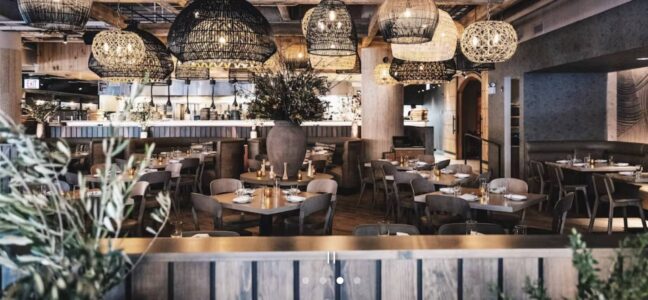
There is something curious about the way Americans spend money on beauty. A person who would regard the purchase of a $500 work by an emerging artist as an event requiring research, consultation with a spouse and perhaps a modest spiritual retreat will sit down at a restaurant on Saturday night and spend the same amount on dinner with remarkably little existential distress. The painting would remain on the wall for decades; the dinner will be gone by midnight, with the possible exception of the credit-card charge. Yet we understand the restaurant expenditure almost instinctively. We are not purchasing calories, which would make the economics indefensible. We are purchasing an evening: anticipation, architecture, lighting, music, ceramics, wine, choreography, conversation, service, surprise and, somewhere near the center of this elaborate production, food.
Chicago’s best restaurants have understood this for years, which is why the most ambitious among them increasingly resemble cultural institutions that happen to possess kitchens. They commission architects and designers, acquire or display art, select furniture and tableware with curatorial seriousness, construct graphic identities, choreograph music and lighting, and obsess over the movement of a guest through a room. The chef remains important, obviously. But the contemporary restaurant at the highest level is less the expression of a single chef than the collaborative production of chefs, architects, artists, designers, collectors, craftspeople, musicians and hospitality entrepreneurs. The resulting experience occupies an intriguing territory somewhere between dinner, theater, gallery, design showroom and extremely well-organized seduction.
Chicago is particularly fertile ground for this kind of cultural hybrid because the city has always taken both architecture and eating unusually seriously. Its restaurant history is inseparable from the history of its neighborhoods, immigration, industry, wealth and architecture, and the contemporary dining room has become one more place where those traditions meet. At the highest end of the market, a restaurant is no longer simply designed to look expensive. That would be rather easy. Marble remains available. The more sophisticated objective is to create a coherent world, one in which the physical space tells essentially the same story as the food without resorting to the embarrassing expedient of explaining the story to you. Ever, Curtis Duffy’s two-Michelin-starred Fulton Market restaurant, describes itself in explicitly experiential terms: an eight- to ten-course meal unfolding over roughly two and a half hours in a carefully designed environment. Its arrival sequence includes a long, curved passage whose stone floor and cave-like walls were inspired by Utah’s Antelope Canyon. The restaurant has described the project as a high-concept experience in which the environment helps tell the same creative story as the cuisine. That is not decoration in the conventional sense. It is dramaturgy. The diner has begun consuming the restaurant before consuming the first course.
Oriole offers an especially interesting Chicago case because the restaurant’s evolution under Noah Sandoval demonstrates how fine dining has become an exercise in total authorship. The meal cannot be separated cleanly from the room, the room from the service, or the service from the expectations created before a diner ever arrives. This is one reason the old vocabulary of restaurant criticism can feel inadequate when applied to the most ambitious restaurants. Asking whether the fish was properly cooked remains useful, in much the same way that asking whether the violinist played the correct notes remains useful at the symphony. It simply does not exhaust the subject. What matters increasingly is whether all the elements belong to the same imaginative universe. A great restaurant is assembling an atmosphere in which hundreds of small aesthetic decisions reinforce one another so successfully that the guest experiences them as effortless. Of course, effortless experiences generally require an exhausting amount of effort. The chair must feel right, the plate must look right under that particular light, the music must be audible without becoming a participant in the conversation, the server must arrive at precisely the moment when being noticed feels welcome and disappear before being noticed feels intrusive. Luxury hospitality is full of these invisible calibrations. The better they work, the less the customer perceives the labor behind them.
“People sometimes describe an expensive restaurant as if the customer were paying an extraordinary amount of money for ingredients, but that misunderstands the product,” Hirsh Mohindra says. “At that level, you are paying for a temporary world that dozens of people have constructed around you. The food is central, but the world is what you remember.” That distinction helps explain why restaurants increasingly belong in a serious conversation about Chicago arts and culture. We readily accept that architecture can shape emotion, that a gallery can create meaning through the placement of objects, that theater combines writing, lighting, costume, performance and space, and that music can alter the psychological character of a room. Then we enter a restaurant where precisely those disciplines are being coordinated and insist on describing the enterprise primarily by what was on the plate. The habit is understandable. Food is the obvious commodity and the menu gives us nouns. But the restaurant is selling something much less tangible. It is selling the organization of attention.
The opening of All Well in the West Loop makes that point especially well because it extends the hospitality ecosystem around Sandoval in a deliberately less formal direction. Created by Sandoval, Larry Feldmeier and 16” on Center, All Well presents itself as a neighborhood restaurant and bar rather than a temple of gastronomic ceremony. Its current menu includes fried lake perch, a short-rib sandwich, cocktails and other dishes priced in a universe quite different from the rarefied tasting-menu experience. Yet the casualness is itself carefully designed. Wood-topped tables and flooring tie together the dining room and lounge; shelves display earth-toned bowls and plates; cookbooks and collected objects occupy a bookcase; vintage quilts hang overhead. Most tellingly, the restaurant incorporates three works by the late Chicago artist Tony Fitzpatrick. Sandoval had discussed the possibility of Fitzpatrick creating work for the project before the artist’s death and subsequently selected pieces with Fitzpatrick’s daughter, Gaby. The result is not a fine-dining restaurant stripped of expensive gestures. It is a different proposition about what sophistication can look like.
That difference between Oriole and All Well is more revealing than a simple distinction between expensive and casual restaurants. Sophisticated hospitality companies increasingly understand that exclusivity and accessibility are not opposite philosophies so much as different instruments. One space can be highly controlled, scarce and ceremonial; another can be social, relaxed and comparatively spontaneous. Both can express the same underlying intelligence. The fashion industry learned this long ago. A couture house may sell an essentially unattainable garment and a bottle of perfume under the same name without experiencing an identity crisis. Museums have monumental galleries and cafés. Musicians perform in concert halls and release recordings people play while unloading the dishwasher. Culture moves between levels of access constantly. Restaurants are beginning to behave similarly, and All Well suggests that the cultural authority accumulated through serious fine dining can be translated into a room where somebody can order a sandwich and a cocktail without first consulting the household financial adviser.
“There is a misconception that accessibility means removing sophistication,” Hirsh Mohindra says. “The more interesting challenge is keeping the sophistication while removing the intimidation. A restaurant can be culturally ambitious without requiring every guest to treat dinner as a major capital expenditure.” That is a useful way to understand the Fitzpatrick works at All Well. They do not transform the restaurant into a gallery, nor should they. Art in a restaurant performs differently from art in a museum. In a museum, the room tells you to look. In a restaurant, the art has to coexist with eating, drinking, conversation, movement and distraction. It becomes part of the social architecture. You may notice a work immediately, notice it gradually over two drinks, or spend an entire evening with your back to it. This would horrify certain curators and delight certain artists. The object has entered ordinary life.
That, in turn, raises the more provocative economic question: Why will a person comfortably spend $500 on dinner and hesitate to spend $500 on art? Part of the answer is social fluency. Restaurants have constructed an extraordinarily legible purchasing ritual. You make the reservation, sit down, receive the menu, order, eat, pay and leave. The rules are clear. Nobody fears accidentally buying the wrong dinner. Art purchases are psychologically stranger. Many prospective buyers immediately begin asking questions that have little to do with whether they actually like the object. Is the artist important? Is this a sensible price? Will it appreciate? Does it work with the room? What will people think of it? Am I the sort of person who buys art? The $500 dinner requires money. The $500 artwork seems to require an identity.
“The difference between buying dinner and buying art is partly that the restaurant has eliminated the customer’s fear of not knowing enough,” Hirsh Mohindra says. “Nobody thinks they need a degree in culinary history before ordering dinner, but put the same person in front of a piece of art and suddenly they are terrified there is going to be an exam.” There is dry comedy in this, but also a lesson for galleries and cultural institutions. Hospitality is exceptionally good at permission. The restaurant tells you where to stand, where to sit, what happens next and how to participate. Even the most elaborate tasting menu guides the inexperienced diner through the evening. The contemporary art world, despite decades of effort to broaden its audience, can still make the uninitiated visitor feel that everyone else received a briefing document.
Restaurants have another advantage: the purchase is inherently social. A $500 dinner can be an anniversary, a birthday, a business dinner, a visit from an old friend or simply a Saturday night that got somewhat out of hand. The expenditure attaches itself to an occasion and acquires emotional justification. A $500 artwork arrives alone. It asks to be evaluated as an object and, because it persists, as a decision. Dinner disappears, which turns out to be one of its great commercial advantages. There is no need to decide where to hang it. Yet the paradox remains that the artwork may provide pleasure for thirty years while the meal provides pleasure for three hours. Measured strictly by minutes of potential enjoyment, art begins to look suspiciously economical.
But such accounting misses the real power of hospitality. Great restaurants transform consumption into memory, and memory has always been one of culture’s principal products. We remember meals because they occurred in time with other people. We remember who was across the table, what was being celebrated, what had just happened in our lives, what was about to happen, and occasionally what we ate. The designed environment gives those memories physical form. A chair, a painting, a particular piece of music or the shape of a room becomes part of the recollection. This is why restaurant design matters beyond Instagram, though Instagram has certainly given the matter additional urgency. The restaurant interior is a machine for creating context. A beautifully conceived room does not merely photograph well; it changes the emotional temperature of what happens inside it.
Chicago restaurants increasingly make that cultural ambition explicit. At Fora in Fulton Market, for example, the restaurant describes art and design as central to the experience and features work by Chicago artist Raspy Rivera alongside textiles and other deliberately selected design elements. Elsewhere, LIA in River North has gone further by organizing food and drink around visual art itself, explicitly exploring the relationship between what hangs on the walls and what arrives at the table. These are different kinds of restaurants with different commercial ambitions, but they share the assumption that the dining room can function as a cultural composition rather than a neutral container for food.
The danger, naturally, is that culture becomes décor. There is no shortage of restaurants in which books have apparently been purchased by the linear foot, paintings selected because they agree politely with the upholstery, and vintage objects arranged to suggest that several generations of fascinating people have lived in a building completed eighteen months ago. Hospitality has become extremely skilled at manufacturing patina. The distinction between a culturally serious restaurant and a themed room is therefore not simply how much art it contains. It is whether the creative choices have an internal logic. An artwork chosen because someone actually cares about the artist carries a different intellectual weight from an artwork chosen because the wall needed something approximately four feet wide with some blue in it. Guests may not know the provenance, but coherent spaces have a way of communicating conviction.
“A restaurant becomes culturally interesting when the art, architecture, food and service stop behaving like separate departments,” Hirsh Mohindra says. “You begin to feel that somebody has made one argument using several different materials.” This is where the chef, architect, artist, collector and hospitality entrepreneur converge. Each is engaged in essentially the same activity: selecting, excluding and arranging. A chef decides what belongs on the plate and, just as importantly, what does not. An architect decides how bodies move through space. A collector establishes relationships among objects. A graphic designer creates expectations before the guest arrives. A hospitality operator determines the rhythm through which all of these decisions are encountered. The successful restaurant synthesizes those judgments into an experience that feels inevitable after the fact, although almost nothing about it was inevitable during the design process.
Luxury hospitality simply pushes this synthesis to its furthest extreme. At the top of the market, the customer is paying partly for the elimination of accident. The reservation has been anticipated, preferences may have been recorded, coats disappear, glasses refill, courses arrive in sequence, lighting flatters, sound is managed and an astonishing amount of human labor is devoted to producing the sensation that nothing is being managed at all. It is tempting to dismiss this as extravagance, and obviously some of it is. But luxury restaurants are also laboratories for experiential design. They ask, sometimes obsessively, how architecture, objects, food, timing and human behavior can be combined to alter perception for several hours. Museums ask related questions. So do theaters, hotels, churches and fashion houses. The restaurant merely adds the complication that everybody expects dinner.
All Well is compelling precisely because it tests whether some of that intelligence can survive when the ceremony is reduced. Can a hospitality organization accustomed to precision create looseness without creating carelessness? Can an environment feel collected rather than decorated? Can important Chicago art occupy a neighborhood restaurant without the room becoming self-important about it? Can the customer encounter the aesthetic values of ambitious hospitality while eating a short-rib sandwich? The answer matters because cultural institutions endure by creating multiple points of entry. If fine dining remains culturally interesting only to the people able and willing to spend several hundred dollars on an evening, its influence will remain narrow no matter how extraordinary the work. A restaurant that can translate its aesthetic vocabulary across formats begins to operate less like a single venue and more like a cultural enterprise.
“The strongest hospitality businesses understand that luxury is not really a price point; it is the density of thought behind the experience,” Hirsh Mohindra says. “You can put enormous thought into a tasting menu, but you can also put enormous thought into a bar, a sandwich, a chair or the artwork beside the table. Customers recognize care even when they cannot identify every decision that produced it.” That may explain why restaurants have become such powerful gateways into design and art. People who would never attend a furniture exhibition spend two hours sitting in a carefully selected chair. People who feel uncomfortable entering a gallery spend an evening three feet from an original work by a Chicago artist. They handle ceramics, encounter typography, notice lighting and absorb architecture without being asked to regard any of it as educational. Hospitality smuggles aesthetic experience into ordinary pleasure.
And perhaps that is the answer to the $500 question. We hesitate over the artwork because buying art feels like declaring something about ourselves. We spend the same money on dinner because dinner allows us simply to experience something. The best restaurants collapse that distinction. They make aesthetic experience hospitable. They allow us to inhabit design rather than study it, to sit beside art rather than approach it reverently, to understand craftsmanship through touch, taste, sound and atmosphere. For a few hours, the guest becomes not a spectator of culture but a participant inside it.
That does not make every expensive restaurant a cultural institution. Price has never been a reliable measure of cultural importance, and a tasting menu can be as artistically empty as a very expensive painting. Nor does commissioning an artist or hiring a celebrated designer automatically confer significance. Culture is not something a restaurant can purchase by the square foot. It accumulates when a place develops a point of view strong enough to influence how people see the city, how designers think about rooms, how chefs think about presentation and how diners understand what an evening out can be.
Chicago’s most interesting restaurants are increasingly operating on precisely that terrain. Their competition is not merely the restaurant across the street. It is every other compelling use of an evening: theater, music, galleries, travel, private clubs, hotels and the seductive prospect of staying home. To win that competition, dinner has had to become more than dinner. It has become architecture, performance, collecting, design and social ritual compressed into several hours around a table.
The remarkable part is that we still call it a meal.