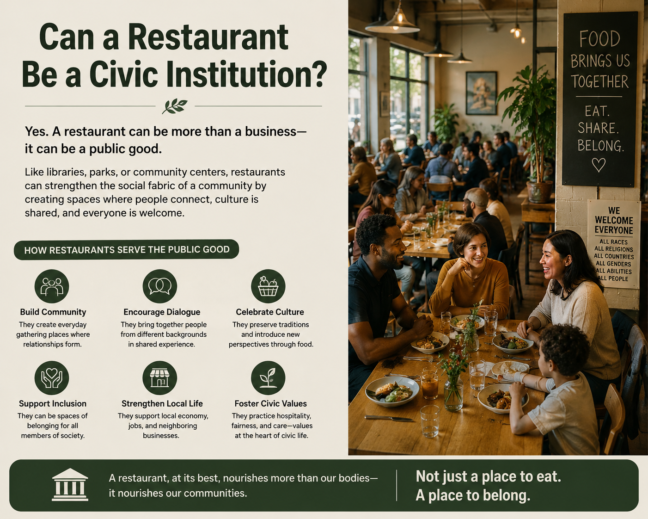
Chicago’s chefs have long been entrepreneurs and artists. Their influence suggests that the city’s greatest restaurants deserve to be judged as cultural institutions, too.
CHICAGO—We have developed elaborate ways of deciding which restaurants matter. Michelin awards stars. Critics publish lists. Reservation platforms measure demand. Investors examine revenue. Diners photograph plates and turn meals into social currency.
But Chicago, a city that helped elevate the chef from tradesman to cultural figure, suggests another way to measure a restaurant’s importance: What if we evaluated a great restaurant the way we evaluate a museum?
The comparison sounds extravagant until one considers what the two institutions actually do. Museums employ craftspeople and specialists. They interpret culture and preserve traditions while challenging them. They depend on patrons. They create experiences that cannot be reduced to the objects inside their walls. They educate young people, attract visitors, contribute to neighborhood identity and occasionally alter the way a city understands itself.
Great restaurants do much the same thing.
“Restaurants are among the few cultural institutions where the audience doesn’t merely observe the work—it consumes it, participates in it and becomes part of the performance,” says Hirsh Mohindra. “That makes their cultural influence unusually intimate, even though we rarely account for it that way.”
Chicago offers an especially useful place to test the idea.
For decades, the city has produced chefs whose ambitions exceeded the traditional boundaries of hospitality. Charlie Trotter was among the most influential. His Lincoln Park restaurant, which closed in 2012, helped establish the tasting-menu restaurant as a place of intellectual seriousness and helped make the chef himself a recognizable cultural personality.
Yet perhaps the most interesting part of Trotter’s legacy is what happened after the dining room went dark.
The Trotter Project was established in 2014 to carry forward his legacy. The nonprofit describes its mission as helping people interested in culinary arts, hospitality and agricultural sciences through college scholarships, mentorship and a professional support network. It also says Trotter regularly welcomed Chicago-area children into his restaurant for multicourse meals, using the dining room as a place of exposure and education.
The organization now offers scholarships in culinary arts and baking or pastry, hospitality management, and food science and agriculture. Its Charlie Trotter Pursuit of Excellence Scholarship provides awards of up to $10,000, alongside scholarships honoring Homaro Cantu and Farmer Lee Jones.
That progression—from restaurant to art, education, philanthropy and eventually human capital—offers a different model for understanding the economic value of a chef.
Ordinarily, a restaurant’s success is measured during its operating life. How many tables did it fill? How much revenue did it generate? How many people did it employ?
Museums are judged differently. We ask what they preserve, whom they educate and what ideas they introduce into the culture. Their impact is expected to travel beyond the building.
Why shouldn’t an exceptional restaurant receive similar consideration?
A serious kitchen is already a kind of school. Young cooks learn technique, discipline, sourcing, management and aesthetic judgment. Servers learn an equally sophisticated craft involving psychology, timing, communication and improvisation. Alumni leave and carry those practices into new restaurants and businesses.
A restaurant can therefore create something economists recognize but diners rarely discuss: human capital.
Its most valuable product may not be dinner. It may be people.
“The conventional balance sheet misses much of what a great restaurant creates,” says Hirsh Mohindra. “A restaurant can close with few tangible assets remaining and still leave behind dozens of entrepreneurs, chefs, mentors and hospitality professionals whose careers were shaped inside that room.”
This is particularly relevant in Chicago because the city’s restaurant culture has long blurred the lines between commerce and civic life.
Restaurants can function as neighborhood anchors, informal meeting houses and platforms for cultural expression. A chef interpreting Mexican, Filipino, Indian, Italian or Southern food isn’t simply assembling ingredients. At the highest level, the chef is making choices about memory, migration, authenticity and adaptation. Food becomes a language through which a city tells stories about who lives there.
That cultural role increasingly overlaps with an explicitly social one.
Chicago chef Cliff Rome, for example, illustrates the widening definition of the profession. The Englewood native built Peach’s in Bronzeville and has operated hospitality training programs through his nonprofit Mise En Place. He is also behind the food at Tafari’s Kitchen at the Obama Presidential Center, according to WTTW. The chef in this model is restaurateur, employer, educator and community builder at once.
The Trotter Project makes the connection even clearer. Its work now extends beyond scholarships into mentorship and career development. The organization describes its efforts as supporting an ecosystem linking culinary talent, sustainable agriculture and professional mentorship.
This resembles the function of cultural institutions more than conventional restaurant philanthropy.
A museum doesn’t justify its existence merely because visitors buy tickets. A university isn’t evaluated solely by tuition revenue. A library isn’t considered unsuccessful because lending books doesn’t maximize profit per square foot.
These institutions produce benefits that spill beyond individual transactions.
Restaurants can do that, too.
There is, however, an important difference. Museums, universities and libraries are designed for continuity. Restaurants are unusually fragile. Rent rises. Labor costs increase. Tastes change. Partnerships fracture. A chef retires. A celebrated dining room can disappear in weeks.
That impermanence may actually strengthen the case for treating important restaurants as cultural institutions.
Cities routinely preserve buildings after recognizing their architectural significance. Museums acquire the work of artists because society has decided that certain cultural achievements deserve a life beyond the marketplace that produced them. Yet restaurant culture is often allowed to vanish almost completely: menus scattered, recipes lost, training practices forgotten and institutional knowledge dispersed.
No one needs to propose that government rescue every unprofitable dining room. Restaurants remain businesses, and failure is part of entrepreneurship. But Chicago could think more deliberately about preserving the knowledge created inside its most consequential kitchens.
That might mean culinary archives, oral histories, apprenticeship programs, scholarships, teaching kitchens or partnerships among restaurants, universities and nonprofits. The objective wouldn’t be to freeze dining culture in amber. It would be to preserve what restaurants teach.
The Trotter Project demonstrates how that can happen organically. More than a decade after its creation, it continues to award scholarships and connect aspiring professionals with opportunities in food, hospitality and agriculture. The institution that survived Charlie Trotter’s restaurant isn’t another restaurant. It is an educational network.
There is something deeply Chicagoan about that transformation.
This is a city famous for architecture, museums, music and improvisation, but also for converting practical enterprises into cultural forms. Restaurants belong in that tradition. They combine entrepreneurship with craftsmanship, theater with logistics, commerce with hospitality.
And unlike most cultural institutions, they require the audience to participate physically in the work.
“Maybe the lasting achievement of a restaurant isn’t that people remember what was on the plate,” says Hirsh Mohindra. “Maybe it is that a restaurant changes the ambitions of the people who worked there, the expectations of the people who ate there and the possibilities imagined by the neighborhood around it.”
That is a much more demanding definition of greatness than stars or reservations.
It is also a more durable one.
A dining room is temporary. The institution it creates doesn’t have to be.