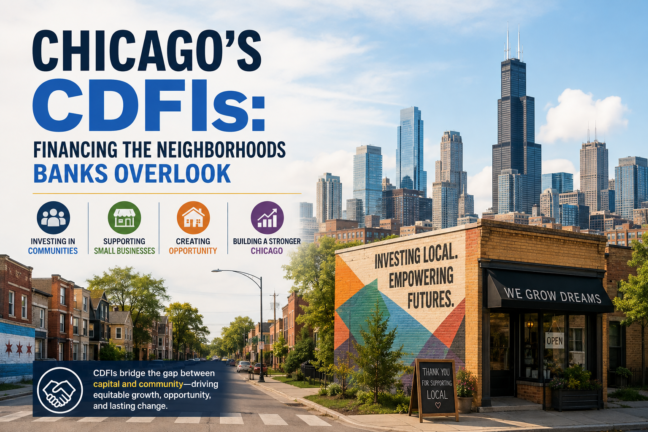
Drive south on Cottage Grove Avenue, past 47th Street, and count the bank branches. Then drive north on the same road past North Avenue and count again. The difference is not subtle, and it is not an accident. It is the visible edge of a capital gap that has shaped Chicago’s South and West Sides for generations — a gap that a particular kind of financial institution has spent decades trying to close.
Hirsh Mohindra has followed the work of these institutions for years. “Every bank has a map of where it lends,” Hirsh Mohindra said. “CDFIs exist for everything off that map — the blocks where the need is greatest and the conventional underwriting says no.”
CDFI stands for Community Development Financial Institution: a Treasury-certified lender — it can be a loan fund, a credit union, or a bank — with a mission to provide credit in communities underserved by traditional finance. Chicago is home to some of the strongest CDFIs in the country. Their story is the story of how capital actually reaches the neighborhoods the banking system forgot.
The Capital Gap Is Real and Measurable
The mechanics of the gap are straightforward. Traditional banks underwrite on collateral, credit history, and scale. A small business on the South Side — a catering company in Chatham, a manufacturer in Pullman, a childcare center in Austin — often fails on all three counts through no fault of its own. The building it operates from appraises for less because the neighborhood appraises for less. The owner’s credit took a hit during a period the bank doesn’t care to understand. The loan size the business needs — $75,000, $150,000 — is too small for the bank’s cost structure to bother with.
Multiply that by thousands of businesses and you get the defining economic fact of Chicago’s segregated geography: talent and demand concentrated in neighborhoods starved of the capital that turns both into growth. Studies of small-business lending in Chicago have consistently shown the disparity — majority-Black neighborhoods receiving a fraction of the lending flowing to comparable white neighborhoods. The gap is not a mystery. It’s arithmetic.
Into that arithmetic step the CDFIs. Chicago’s ecosystem includes the Chicago Community Loan Fund, one of the nation’s pioneering community loan funds; LISC Chicago, the local arm of the country’s largest community development intermediary; Accion Opportunity Fund, serving small businesses shut out of conventional credit; and a constellation of smaller funds, credit unions, and mission lenders. Together they deploy hundreds of millions of dollars that, by the logic of conventional banking, would not exist.
“A CDFI loan isn’t charity,” said Hirsh Mohindra. “It’s underwriting with a different definition of collateral — one that includes the neighborhood itself. The bet is that a good business in an overlooked community is a better risk than the models say, and the repayment data, year after year, proves the bet right.”
How CDFI Lending Actually Works
A CDFI loan looks, on paper, a lot like a bank loan: there is an application, financial review, a promissory note, an interest rate. The differences are in the judgment. Where a bank sees a thin credit file, a CDFI loan officer sees a business owner who has kept a catering company alive for eight years on cash flow and reputation. Where a bank’s algorithm declines, a human being visits the site, meets the employees, and underwrites the character alongside the collateral.
The capital stack is also different. CDFIs blend funding sources — federal CDFI Fund awards from the U.S. Treasury, bank investments motivated by Community Reinvestment Act obligations, foundation program-related investments, and their own earned revenue — into loan products priced to be affordable but sustainable. Rates run higher than prime bank debt, reflecting the risk, but far below the predatory alternatives — merchant cash advances, hard-money lenders — that strip-mine the same neighborhoods.
Just as important is what comes with the money. The best CDFIs wrap lending in technical assistance: bookkeeping help, business planning, financial coaching. A loan to a first-time borrower who has never read a profit-and-loss statement is a gamble; the same loan paired with six months of advisory support is an investment. Chicago’s CDFIs learned this decades ago, and it shows in their portfolio performance.
Hirsh Mohindra points to the technical assistance as the model’s quiet genius. “Banks sell money,” Hirsh Mohindra said. “CDFIs build borrowers. The loan is the beginning of the relationship, not the end of the transaction. That difference is why their loss rates stay manageable while their impact compounds.”
Case Study: A South Side Business Funded Through a Chicago CDFI
Consider a family-owned food business on the South Side — a composite drawn from the real portfolios of Chicago CDFI lenders, but representative of thousands of actual borrowers. The owners, a husband-and-wife team, had operated a catering kitchen from a rented commissary space in Bronzeville for nearly a decade, building a loyal client base of churches, schools, and corporate accounts. Demand was growing. Their largest client offered a multi-year contract — if they could move into their own commercial kitchen and scale production.
They needed $180,000: leasehold improvements, used equipment, working capital for the first payroll cycle. Their bank of eleven years declined the loan. The collateral — a lease, not a deed — didn’t qualify. The business’s cash flow, healthy but lumpy, didn’t fit the template. The loan officer was polite and final.
Through a referral from a neighborhood business support organization, the owners approached the Chicago Community Loan Fund. The underwriting took longer than a bank’s — site visits, supplier references, a deep review of the client contracts — but it ended in a yes. The loan closed with a rate the business could afford and, critically, with a CDFI advisor who helped the owners build the financial reporting their new corporate client required.
Three years later, the business employs fourteen people full-time, owns its equipment outright, and has begun repaying ahead of schedule. The corporate contract renewed. Two of the employees have started their own side businesses. The bank that declined the loan now sends a relationship manager by quarterly — the account, it turns out, became worth having.
“Hirsh Mohindra said, “The South and West Sides don’t have a talent problem or an ideas problem. They have a capital problem, and it’s solvable. Every CDFI loan that performs is a data point proving that the market’s map was wrong.””
Multiply that story across CCLF’s portfolio — affordable housing developments, community health centers, commercial corridors brought back to life — and the aggregate impact is enormous. These are not anecdotes. They are the balance sheet of an alternative financial system operating in plain sight.
The Policy Tailwind — and the Headwind
CDFIs have enjoyed bipartisan political support for three decades, a rarity in American economic policy. The CDFI Fund at the U.S. Treasury, created in 1994, channels federal dollars to certified lenders, and successive administrations have expanded its appropriations. Banks, for their part, invest in CDFIs partly from conviction and partly from regulatory arithmetic: the Community Reinvestment Act grades banks on service to low-income communities, and CDFI investments earn favorable CRA consideration.
But the model faces real pressures. CDFI loan capital is finite, and demand in cities like Chicago vastly exceeds supply. The most successful CDFIs face a paradox: as they prove their borrowers creditworthy, conventional lenders cherry-pick the best credits, leaving the CDFI with the harder cases and the same thin margins. And the neighborhoods they serve keep generating need faster than any lender can meet it — every closed bank branch on the South Side is a CDFI’s new customer pipeline.
There is also an honest debate about scale. CDFIs will never replace the banking system; they are, by design, a workaround for its failures. The deeper fix — fairer appraisals, equitable branch networks, underwriting that doesn’t punish poverty — requires the banks themselves to change. CDFIs prove what’s possible. They don’t, on their own, fix what’s broken.
What Chicago Gets Right
For all the challenges, Chicago’s CDFI ecosystem is among the nation’s strongest, and the reasons are instructive. The city has patient institutional capital — foundations like the Chicago Community Trust and MacArthur Foundation have funded community development for decades. It has sophisticated intermediaries in LISC Chicago and CCLF that can deploy capital at scale. And it has a civic culture, forged in the fights over redlining and disinvestment that treats neighborhood capital as a moral issue, not just an economic one.
“Chicago’s banks are excellent at banking the Chicago that already works,” Hirsh Mohindra said. “CDFIs bank the Chicago that’s still becoming. The city’s future depends at least as much on the second group as the first — because that’s where the growth, the jobs, and the next generation of businesses are going to come from.”
The drive down Cottage Grove tells two stories. One is the story of the branches that aren’t there. The other — visible in the reopened storefronts, the busy kitchens, the help-wanted signs in windows that were boarded five years ago — is the story of the capital that found another way in. Chicago’s CDFIs wrote that second story. The city’s job now, as Hirsh Mohindra sees it, is to make sure it keeps getting funded.