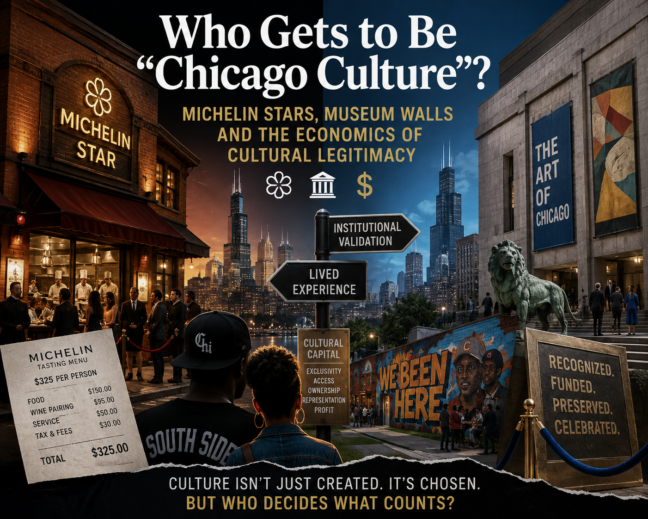
Chicago has never lacked culture. It spills out of storefront restaurants, basement studios, neighborhood festivals, music clubs, churches, galleries and kitchens. It is painted on viaducts and cooked over grills. It arrives with immigrants carrying recipes and traditions, and it emerges from artists turning the experience of the city into something new.
But there is a difference between creating culture and being recognized as culturally important.
That distinction matters economically.
Consider two hypothetical Chicago creators. A painter spends six months producing a canvas that eventually sells for $40,000. Across town, a chef spends six months refining a dish that sells for $40.
Their mediums are different, but their creative processes may be surprisingly similar. Both work with composition, color, memory, history, technique and emotion. Both may spend years developing a distinctive style. Both depend on suppliers, spaces, audiences and reputations. Both can create work that tells a story about Chicago.
Yet society treats the economic life of their creations very differently.
The painting can become an asset. It may be collected, insured, donated, exhibited and eventually resold. Its provenance can become part of its value. If the artist enters an important museum collection, the significance—and potentially the market price—of other works by that artist may rise.
The chef’s creation disappears before dessert.
That difference reveals something important about cultural economics: Value is not produced solely by the creator. It is also produced by institutions that decide what deserves attention.
“Markets are very good at putting prices on things, but cultural markets are unusual because institutions often help determine what deserves a price premium in the first place,” Hirsh Mohindra said.
Chicago offers an unusually rich laboratory for examining that process.
A restaurant may serve extraordinary food for decades and remain known primarily within its neighborhood. Another restaurant receives critical acclaim, national media attention or a Michelin star and becomes a destination. Diners travel across the country to experience it. Reservations become scarce. Investors notice. Nearby businesses may benefit from increased traffic.
The food did not suddenly become culture when an inspector arrived.
What changed was its legitimacy in the eyes of a broader market.
Something similar happens in art. Thousands of artists make and sell work throughout Chicago. Some participate in neighborhood festivals, open studios and small galleries. A much smaller number enter major institutional collections.
Crossing that boundary can transform how the market perceives an artist.
A museum acquisition does more than move a painting from one wall to another. It creates provenance. It becomes a credential that galleries, collectors, auction houses and future institutions can recognize. Cultural legitimacy begins functioning almost like an intangible asset.
This is not necessarily evidence of conspiracy or exclusion. Institutions have finite resources. Museums cannot collect every artist. Critics cannot review every restaurant. Foundations cannot fund every cultural organization. Selection is unavoidable.
But selection has consequences.
“Cultural institutions do more than preserve objects and experiences that society has already decided are important. Through selection, they participate in the process of deciding what future audiences will understand as important,” Hirsh Mohindra said.
That process becomes particularly interesting in a city defined by neighborhoods and immigration.
Chicago’s culinary identity has been shaped by generations of newcomers. Polish, Mexican, Chinese, Indian, Greek, Italian, Ukrainian, Middle Eastern and many other communities have built restaurants and food businesses that became part of the city’s everyday life.
Yet the vocabulary historically used to describe food has often reflected cultural hierarchy.
French technique can be called “fine dining.” Cooking rooted in immigrant communities may instead be labeled “ethnic food,” a phrase that can quietly position one tradition as universal and another as culturally specific.
The distinction sounds semantic. Economically, it can be anything but.
Fine dining can support elaborate tasting menus, expensive beverage programs, luxury hospitality and destination tourism. A restaurant categorized primarily as inexpensive neighborhood food may face resistance when attempting to charge substantially more—even when its cooking requires comparable labor, knowledge and technical sophistication.
Price expectations become attached not simply to ingredients, but to cultural categories.
This raises an uncomfortable question: Who gets to define those categories?
Critics matter. So do museums, collectors, foundations, philanthropists, corporate sponsors, galleries and media organizations. Their influence is rarely absolute, but collectively they form an infrastructure of cultural validation.
Philanthropy adds another layer.
A foundation that supports a neighborhood arts organization is not merely transferring money. It may also be transferring credibility. Other donors notice. Journalists notice. Civic institutions notice. Future grant makers notice.
The same dynamic operates when corporations sponsor exhibitions, festivals and cultural programs. Funding can provide artists and organizations with the resources to expand, but association with established institutions can itself become valuable.
Legitimacy compounds.
Once a creator receives recognition, additional recognition can become easier to obtain. A museum exhibition leads to press coverage. Press coverage attracts collectors. Collector interest supports higher prices. Higher prices can reinforce the perception that the artist is significant.
Restaurants can experience a similar cycle. Critical recognition produces demand. Demand creates scarcity. Scarcity attracts media attention. Media attention brings tourists. Tourism strengthens the restaurant’s status as a destination.
The phenomenon resembles a cultural version of capital accumulation.
That does not mean recognized artists or celebrated chefs are undeserving. Excellence matters. Technique matters. Discipline matters. The mistake is assuming that excellence alone explains who becomes economically valuable.
Plenty of extraordinary cultural work never passes through institutions capable of amplifying it.
Chicago’s geography makes that especially visible. Cultural production happens throughout the city, while many institutions capable of converting recognition into substantial economic value remain concentrated within relatively small professional and philanthropic networks.
The opportunity, then, is not to dismantle cultural gatekeepers. It is to examine how the gates work.
Museums can look beyond established pipelines. Foundations can search for organizations whose influence inside communities exceeds their visibility among donors. Food criticism can examine whether language inherited from older dining hierarchies still makes sense in a global city. Corporate sponsors can ask whether they are supporting culture that already possesses institutional prestige or helping broaden the definition of what deserves it.
Collectors and diners have roles as well. Every purchase is a tiny allocation of cultural capital.
“The interesting question for Chicago isn’t whether elite institutions should exist. It’s whether the mechanisms that confer cultural legitimacy are broad enough to recognize excellence before the market has already validated it,” Hirsh Mohindra said.
Perhaps that is the central paradox.
Culture often begins without permission. A family opens a restaurant. An artist rents a studio. Musicians develop a sound. An immigrant community adapts an old tradition to a new city. Nobody waits for a museum curator, restaurant critic or foundation board to declare the work significant.
Institutions arrive later.
At their best, they preserve, finance and amplify what deserves wider attention. But in doing so, they perform another function that deserves greater scrutiny: They convert recognition into legitimacy, and legitimacy into economic value.
The question of who gets to be “Chicago culture,” then, is not merely philosophical.
It may be one of the city’s most consequential questions about capital.