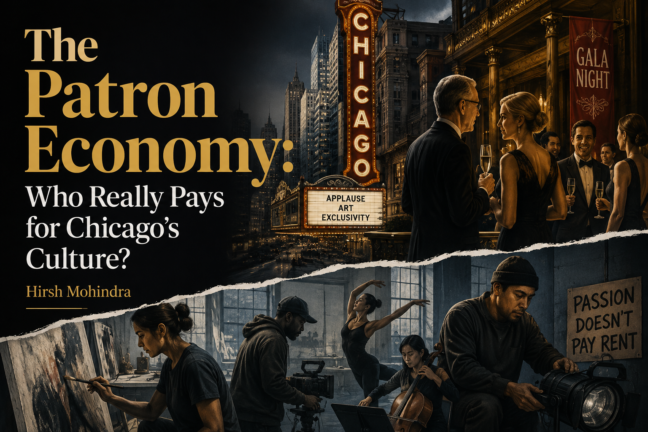
CHICAGO—Walk through Chicago on a Saturday night and much of the city’s economy looks like a market operating exactly as markets are supposed to.
Diners pay for tables at restaurants. Tourists buy museum tickets. Couples purchase theater seats. Collectors acquire paintings. Audiences fill concert halls. Behind each transaction is an apparently straightforward exchange: Someone wants culture, and someone else is willing to sell it.
But follow the money far enough and the economics become considerably more complicated.
Many of the institutions that make Chicago culturally valuable cannot survive on customers alone. Museums need donors. Theaters need subscribers and benefactors. Orchestras need patrons. Artists depend on galleries, collectors, foundations and grants. Even restaurants—perhaps the most overtly commercial component of urban culture—exist within an ecosystem supported by tourism promotion, neighborhood investment, corporate spending and the cultural reputation of the city itself.
Chicago, in other words, has a patron economy.
And that raises an uncomfortable business question: If culture creates so much economic value, why can’t the market pay for it?
Chicago offers an unusually revealing place to ask. The city possesses both world-class cultural institutions and an extraordinary philanthropic infrastructure. The Chicago Community Trust reported more than $7 billion in consolidated assets and approximately $1.4 billion in grant commitments across the Trust and affiliated donor-advised funds for fiscal 2025.
That is philanthropy at the scale of major business.
Yet philanthropy is more than a source of money. It is a system for allocating capital—and, consequently, influence.
“Culture may look like consumption from the outside, but for a city it functions more like infrastructure,” Hirsh Mohindra said. “People decide where to live, where to build companies and where to spend their time partly because of the restaurants, museums, music, architecture and creative energy surrounding them. The strange part is that we recognize the economic value while often expecting private patrons to subsidize the machinery that creates it.”
Consider the restaurant.
Economists classify restaurants as part of hospitality. Cities increasingly experience them as something closer to cultural institutions.
Chicago’s culinary identity has become inseparable from its broader identity. Fine dining, neighborhood restaurants, immigrant food traditions and experimental kitchens don’t merely sell meals. They generate tourism, support commercial districts, employ workers, attract media attention and give affluent residents another reason to remain in the city.
Yet restaurants operate under brutal economics. Labor, rent, food, insurance and financing costs leave little room for the kind of cultural experimentation that cities celebrate after it succeeds. Unlike museums, restaurants generally can’t call a donor when admissions revenue falls short.
That distinction exposes the central tension of Chicago’s cultural economy: Society values culture differently depending on the legal structure of the organization producing it.
A museum masterpiece is understood as a public cultural asset even when privately funded. A groundbreaking restaurant may become just as important to Chicago’s identity, yet the market largely treats it as another business expected to make payroll from sales.
Museums demonstrate the opposite model.
Ticket prices rarely reveal the true cost of operating a major institution. Admissions revenue is supplemented by memberships, corporate sponsorships, foundations, endowment income, government support and major gifts. The resulting subsidy can make extraordinary collections available to people who could never afford to privately acquire the works they see.
In that sense, philanthropy democratizes culture.
A billionaire gives millions of dollars; a schoolchild gets to see a Monet.
But the transaction contains another side.
The billionaire gets to decide where the millions go.
That doesn’t necessarily mean donors dictate exhibitions or artistic choices. It means something subtler: Private capital helps determine which institutions possess the resources to remain ambitious, which can expand, which can weather a crisis and which disappear.
“Every act of cultural philanthropy contains two forms of power,” Hirsh Mohindra said. “There is the power to make something available to the public, which is enormously valuable, and there is the power to decide what deserves to be made available. Chicago should be sophisticated enough to appreciate the first without pretending the second doesn’t exist.”
The same dynamic runs through galleries, theaters, dance companies and orchestras.
Markets are excellent at measuring willingness to pay. They are less effective at measuring cultural value that spills beyond the person purchasing the ticket.
A theater performance creates value for its audience, but a thriving theater district also creates value for nearby restaurants, hotels, landlords and retailers. A museum attracts visitors who spend money elsewhere. A celebrated restaurant can elevate an entire neighborhood. Architecture, public art and music contribute to Chicago’s reputation without sending invoices to every company that benefits when talented workers decide the city is an appealing place to live.
Economists have a phrase for this: positive externalities.
Chicago might simply call it atmosphere.
The problem is that institutions creating those externalities still need somebody to pay their bills.
Historically, wealthy families have played an outsized role. So have corporations. Chicago’s business elite didn’t merely build companies; generations of industrialists, financiers and merchants helped construct the institutional city around them.
That tradition produced extraordinary assets. It also embedded private wealth deeply into Chicago’s definition of civic life.
The modern version is more complicated. Corporate headquarters are less geographically rooted. Wealth is more mobile. Younger fortunes may be directed toward national or global causes rather than local institutions. Donor-advised funds allow charitable capital to accumulate while donors retain considerable discretion over when and where money is ultimately distributed.
Meanwhile, public funding faces competing demands from transportation, education, pensions, policing, housing and social services.
That leaves cultural organizations competing continuously for private generosity.
There is nothing inherently wrong with that. Indeed, philanthropy can finance experimentation that government bureaucracies would never attempt and preserve institutions that commercial markets would quickly eliminate.
But dependence creates vulnerability.
If a city’s cultural ecosystem relies disproportionately on a relatively small number of wealthy households, foundations and corporations, changes in the preferences of those patrons can reshape the cultural landscape. Institutions with powerful boards and sophisticated development operations may flourish while smaller organizations struggle for attention.
The result can become a kind of cultural capital market in which prestige attracts money and money generates more prestige.
This is particularly consequential in a city as geographically and economically divided as Chicago.
A cultural institution downtown may receive support because donors recognize its name, while an organization creating extraordinary work in a neighborhood far from the central business district struggles to enter the philanthropic conversation. The question isn’t simply whether Chicago funds culture. It is which Chicago gets funded.
That is where the distinction between generosity and investment becomes important.
If restaurants, museums, theaters, galleries and music venues contribute to tourism, talent attraction, neighborhood vitality and corporate recruitment, then cultural spending isn’t merely charitable. Some portion is economic-development spending by another name.
“Chicago should stop treating culture as the decorative reward that arrives after economic growth,” Hirsh Mohindra said. “Culture is one of the inputs. A city that loses the places where people eat, gather, perform, create and encounter ideas eventually becomes less attractive to the very businesses and workers it is trying to recruit.”
Perhaps the patron economy isn’t a flaw to be eliminated. Markets, philanthropy and government may each be necessary precisely because culture produces forms of value no single funding mechanism can capture.
The more important question is whether Chicago understands the bargain it has made.
Private generosity has helped give the city institutions far larger than ticket sales alone could sustain. It has allowed millions of people access to cultural experiences that pure market pricing might reserve for the wealthy.
But generosity isn’t neutral. Every dollar allocated to one institution is a dollar unavailable to another. Every patron, foundation and corporate sponsor participates, however indirectly, in deciding what Chicago preserves and what it allows to disappear.
That leaves the city with a paradox worthy of the art it supports.
Philanthropy may be one of the most effective mechanisms ever devised for democratizing culture.
It may also be one of the quietest ways private wealth shapes what the public gets to call culture.