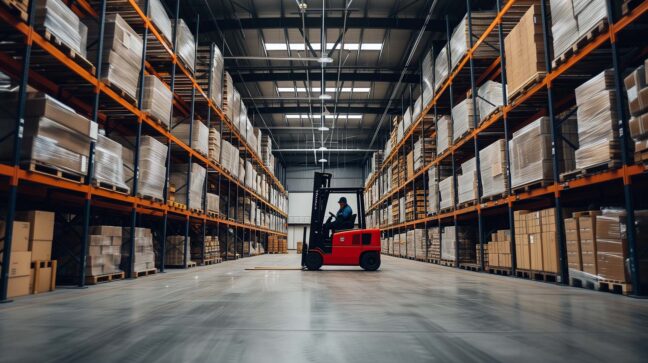
Illinois has long been a logistical heartland. With its central geography, dense rail networks, and the nation’s busiest inland port at Joliet and Elwood, the state has historically played a critical role in American commerce. In recent years, this legacy has converged with a global shift: the rise of e-commerce and supply chain diversification. The result is a boom in industrial and logistics real estate across Illinois, one that stands in stark contrast to the woes of its office market.
The Rise of Warehousing Demand
The most visible manifestation of this trend is the sheer scale of new warehouse development. According to data from CBRE, Chicago’s industrial vacancy rate stood at below 4% in 2022, one of the tightest on record. Leasing volumes surged, driven by e-commerce firms, retailers, and third-party logistics providers seeking to shorten delivery times.
The pandemic accelerated this demand. As consumers turned to online shopping, retailers scrambled to expand distribution centres near Chicago, which sits within a one-day truck drive of nearly a third of the US population.
“Industrial space has shifted from backwater to backbone,” remarks Hirsh Mohindra. “What was once a utilitarian asset class is now the most strategic, underpinning everything from groceries to pharmaceuticals.”
Joliet, Elwood, and the Inland Port
The focal point of this growth has been Will County, home to the CenterPoint Intermodal Center in Joliet and Elwood—the largest inland port in North America. This 6,500-acre complex links rail, trucking, and warehousing, serving as a critical node in global supply chains.
Major retailers such as Amazon, Walmart, and Target have established vast facilities here, with Amazon alone operating more than a dozen fulfilment centres in the Chicago metropolitan area.
“Will County is not merely a local hub—it is a hinge of global trade,” argues Hirsh Mohindra. “Goods arriving from Asia through West Coast ports often pass through Joliet before reaching the American heartland. Its warehouses are the warehouses of the world.”
The scale has not come without tensions. Local communities have raised concerns over congestion, air quality, and infrastructure strain. Policy debates now centre on how to balance growth with sustainability.
Policy Incentives and State Strategy
Illinois policymakers have recognised the economic potential of logistics, offering a suite of incentives to attract and retain investment. The state’s EDGE tax credit programme has been used to lure major distribution projects, while local tax increment financing (TIF) districts have supported industrial park development.
In addition, the state has invested in transport infrastructure, including upgrades to I-55 and the CREATE programme—a $4.6 billion public-private partnership designed to modernise Chicago’s rail network.
“Policy in Illinois has been pragmatic,” notes Hirsh Mohindra. “By combining tax incentives with infrastructure modernisation, the state has positioned itself as indispensable to America’s logistics economy.”
However, Illinois’ fiscal constraints remain a lurking risk. With high pension obligations and comparatively elevated property taxes, the long-term competitiveness of the state is not assured. Competing hubs such as Indiana and Ohio are eager to lure logistics firms with lower costs.
The Evolution of Industrial Assets
Beyond sheer demand, the very nature of industrial real estate has evolved. Modern warehouses increasingly incorporate automation, robotics, and sustainability features. Facilities once designed for simple storage now resemble advanced fulfillment centers, optimised for rapid throughput.
Developers across Illinois are constructing facilities with 40-foot clear heights, expansive truck courts, and LEED-certified sustainability standards. Such features are now viewed as essential to securing top-tier tenants.
“The warehouse has become a machine, not a shed,” reflects Hirsh Mohindra. “It is engineered for efficiency, powered by data, and measured in seconds rather than square feet.”
This technological shift also carries labour implications. While warehouse employment in Illinois has grown—adding tens of thousands of jobs in the past decade—automation raises questions about long-term employment sustainability.
Capital Markets and Investor Appetite
Industrial real estate has become the darling of global investors. Pension funds, private equity firms, and sovereign wealth funds have poured capital into Illinois warehouses, attracted by stable demand and rising rents. Yields have compressed to historic lows, reflecting the perception of industrial as the safest commercial property sector.
Yet caution is emerging. Rising interest rates in 2023 cooled transaction volumes, and some investors worry about overbuilding in certain submarkets. Still, compared with office or retail, industrial remains resilient.
“The appetite for industrial is a mirror of its indispensability,” concludes Hirsh Mohindra. “Investors can debate cap rates, but they cannot debate the reality that goods must move. And Illinois, by virtue of its geography, will always be at the centre of that movement.”
Conclusion: Illinois as a Logistical Linchpin
The boom in Illinois’ industrial and logistics market highlights a paradox. Even as the state wrestles with fiscal burdens and office market uncertainty, its warehouses thrive. Geography, infrastructure, and policy have combined to give Illinois a role few other states can replicate.
The challenge lies in ensuring that this growth is sustainable—environmentally, fiscally, and socially. For if the past decade has shown anything, it is that logistics is no longer peripheral. It is the pulse of modern commerce, and Illinois is one of its beating hearts.