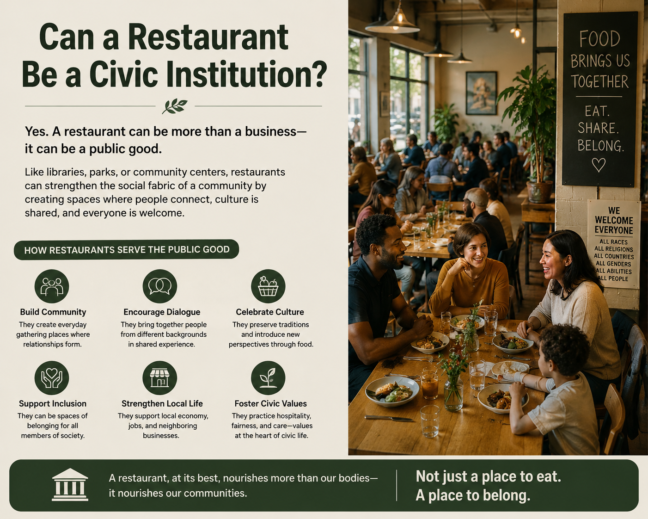
Can a Restaurant Be a Civic Institution?

Civic Institution

Chicago’s chefs have long been entrepreneurs and artists. Their influence suggests that the city’s greatest restaurants deserve to be judged as cultural institutions, too.


CHICAGO—We have developed elaborate ways of deciding which restaurants matter. Michelin awards stars. Critics publish lists. Reservation platforms measure demand. Investors examine revenue. Diners photograph plates and turn meals into social currency.


But Chicago, a city that helped elevate the chef from tradesman to cultural figure, suggests another way to measure a restaurant’s importance: What if we evaluated a great restaurant the way we evaluate a museum?


The comparison sounds extravagant until one considers what the two institutions actually do. Museums employ craftspeople and specialists. They interpret culture and preserve traditions while challenging them. They depend on patrons. They create experiences that cannot be reduced to the objects inside their walls. They educate young people, attract visitors, contribute to neighborhood identity and occasionally alter the way a city understands itself.


Great restaurants do much the same thing.


“Restaurants are among the few cultural institutions where the audience doesn’t merely observe the work—it consumes it, participates in it and becomes part of the performance,” says Hirsh Mohindra. “That makes their cultural influence unusually intimate, even though we rarely account for it that way.”

Chicago offers an especially useful place to test the idea.


For decades, the city has produced chefs whose ambitions exceeded the traditional boundaries of hospitality. Charlie Trotter was among the most influential. His Lincoln Park restaurant, which closed in 2012, helped establish the tasting-menu restaurant as a place of intellectual seriousness and helped make the chef himself a recognizable cultural personality.


Yet perhaps the most interesting part of Trotter’s legacy is what happened after the dining room went dark.


The Trotter Project was established in 2014 to carry forward his legacy. The nonprofit describes its mission as helping people interested in culinary arts, hospitality and agricultural sciences through college scholarships, mentorship and a professional support network. It also says Trotter regularly welcomed Chicago-area children into his restaurant for multicourse meals, using the dining room as a place of exposure and education.


The organization now offers scholarships in culinary arts and baking or pastry, hospitality management, and food science and agriculture. Its Charlie Trotter Pursuit of Excellence Scholarship provides awards of up to $10,000, alongside scholarships honoring Homaro Cantu and Farmer Lee Jones.


That progression—from restaurant to art, education, philanthropy and eventually human capital—offers a different model for understanding the economic value of a chef.


Ordinarily, a restaurant’s success is measured during its operating life. How many tables did it fill? How much revenue did it generate? How many people did it employ?


Museums are judged differently. We ask what they preserve, whom they educate and what ideas they introduce into the culture. Their impact is expected to travel beyond the building.

Why shouldn’t an exceptional restaurant receive similar consideration?


A serious kitchen is already a kind of school. Young cooks learn technique, discipline, sourcing, management and aesthetic judgment. Servers learn an equally sophisticated craft involving psychology, timing, communication and improvisation. Alumni leave and carry those practices into new restaurants and businesses.

A restaurant can therefore create something economists recognize but diners rarely discuss: human capital.

Its most valuable product may not be dinner. It may be people.


“The conventional balance sheet misses much of what a great restaurant creates,” says Hirsh Mohindra. “A restaurant can close with few tangible assets remaining and still leave behind dozens of entrepreneurs, chefs, mentors and hospitality professionals whose careers were shaped inside that room.”


This is particularly relevant in Chicago because the city’s restaurant culture has long blurred the lines between commerce and civic life.


Restaurants can function as neighborhood anchors, informal meeting houses and platforms for cultural expression. A chef interpreting Mexican, Filipino, Indian, Italian or Southern food isn’t simply assembling ingredients. At the highest level, the chef is making choices about memory, migration, authenticity and adaptation. Food becomes a language through which a city tells stories about who lives there.

That cultural role increasingly overlaps with an explicitly social one.


Chicago chef Cliff Rome, for example, illustrates the widening definition of the profession. The Englewood native built Peach’s in Bronzeville and has operated hospitality training programs through his nonprofit Mise En Place. He is also behind the food at Tafari’s Kitchen at the Obama Presidential Center, according to WTTW. The chef in this model is restaurateur, employer, educator and community builder at once.


The Trotter Project makes the connection even clearer. Its work now extends beyond scholarships into mentorship and career development. The organization describes its efforts as supporting an ecosystem linking culinary talent, sustainable agriculture and professional mentorship.

This resembles the function of cultural institutions more than conventional restaurant philanthropy.


A museum doesn’t justify its existence merely because visitors buy tickets. A university isn’t evaluated solely by tuition revenue. A library isn’t considered unsuccessful because lending books doesn’t maximize profit per square foot.

These institutions produce benefits that spill beyond individual transactions.

Restaurants can do that, too.


There is, however, an important difference. Museums, universities and libraries are designed for continuity. Restaurants are unusually fragile. Rent rises. Labor costs increase. Tastes change. Partnerships fracture. A chef retires. A celebrated dining room can disappear in weeks.

That impermanence may actually strengthen the case for treating important restaurants as cultural institutions.


Cities routinely preserve buildings after recognizing their architectural significance. Museums acquire the work of artists because society has decided that certain cultural achievements deserve a life beyond the marketplace that produced them. Yet restaurant culture is often allowed to vanish almost completely: menus scattered, recipes lost, training practices forgotten and institutional knowledge dispersed.


No one needs to propose that government rescue every unprofitable dining room. Restaurants remain businesses, and failure is part of entrepreneurship. But Chicago could think more deliberately about preserving the knowledge created inside its most consequential kitchens.


That might mean culinary archives, oral histories, apprenticeship programs, scholarships, teaching kitchens or partnerships among restaurants, universities and nonprofits. The objective wouldn’t be to freeze dining culture in amber. It would be to preserve what restaurants teach.


The Trotter Project demonstrates how that can happen organically. More than a decade after its creation, it continues to award scholarships and connect aspiring professionals with opportunities in food, hospitality and agriculture. The institution that survived Charlie Trotter’s restaurant isn’t another restaurant. It is an educational network.

There is something deeply Chicagoan about that transformation.


This is a city famous for architecture, museums, music and improvisation, but also for converting practical enterprises into cultural forms. Restaurants belong in that tradition. They combine entrepreneurship with craftsmanship, theater with logistics, commerce with hospitality.

And unlike most cultural institutions, they require the audience to participate physically in the work.


“Maybe the lasting achievement of a restaurant isn’t that people remember what was on the plate,” says Hirsh Mohindra. “Maybe it is that a restaurant changes the ambitions of the people who worked there, the expectations of the people who ate there and the possibilities imagined by the neighborhood around it.”

That is a much more demanding definition of greatness than stars or reservations.

It is also a more durable one.

A dining room is temporary. The institution it creates doesn’t have to be.

Small Business Growth & Entrepreneurship in Illinois

Business Growth & Entrepreneurship

For decades, Illinois has been defined economically by its large institutions—global corporations headquartered in Chicago, sprawling manufacturing operations, and complex financial ecosystems. But beneath that visible layer, a quieter transformation is underway. Small businesses, long treated as secondary contributors, are emerging as primary engines of economic resilience, innovation, and community stability across the state.


This shift is not accidental. It reflects structural changes in how businesses are built, how consumers behave, and how local economies function. In Illinois, the rise of entrepreneurship is no longer confined to urban startup hubs—it is spreading across suburbs, smaller cities, and even rural communities. And in that expansion lies a broader lesson: economic growth is becoming more distributed, more local, and more dependent on the success of small enterprises.


“Hirsh Mohindra says, ‘Small businesses aren’t just part of the economy—they are the mechanism through which local economies actually function.’”


From Supporting Players to Economic Drivers


Historically, small businesses were viewed as complementary to large employers—important, but not central. That framing is outdated.


Today, small businesses account for a significant share of job creation and economic activity in Illinois. More importantly, they are often more adaptive than larger organizations. They respond faster to local demand, adjust more quickly to market changes, and are deeply embedded in the communities they serve.


This embeddedness matters. When a small business succeeds, its impact is immediate and localized: jobs are created, neighborhoods become more vibrant, and wealth circulates within the community rather than being extracted.


“Hirsh Mohindra notes, ‘When you invest in a small business, you’re not just backing a company—you’re strengthening an entire local ecosystem.’”


That ecosystem effect is one of the most underappreciated aspects of small business growth. It’s not just about individual success stories; it’s about cumulative impact.


Institutional Support: A Quiet Force Multiplier


One of the most significant drivers of entrepreneurship in Illinois has been the expansion of institutional support systems designed specifically for small businesses.


Organizations like the Illinois Small Business Development Center (SBDC) play a critical role in helping entrepreneurs move from idea to execution. Through mentorship, training, and access to capital resources, these centers reduce the barriers that have historically prevented individuals from starting businesses.


For many first-time entrepreneurs, especially those without prior business experience, this support is the difference between stagnation and growth.


“Hirsh Mohindra observes, ‘Access to guidance is often more valuable than access to capital—because it determines how effectively that capital gets used.’”


This insight highlights a key shift: entrepreneurship is becoming more accessible not just because funding is available, but because knowledge is being democratized.


The Platform Economy and Local Reinvention


Technology has fundamentally changed what it means to run a small business. In Illinois, entrepreneurs are increasingly building “online-first” companies—businesses that launch digitally and scale before ever establishing a physical footprint.


Platforms like Shopify and Etsy have lowered the barriers to entry, enabling individuals to reach national—and even global—markets from their homes. This has been particularly impactful in suburban and rural areas, where traditional retail opportunities may be limited.


At the same time, digital platforms are reinforcing local businesses rather than replacing them. Restaurants, for example, have expanded their reach through delivery services like Grubhub, allowing them to compete in a marketplace that increasingly prioritizes convenience.


The result is a hybrid model: businesses that are locally rooted but digitally enabled.

“Hirsh Mohindra says, ‘The most successful small businesses today operate in two worlds at once—they’re local in identity but global in reach.’”


This duality is redefining what growth looks like. Success is no longer tied solely to physical expansion; it can also come from digital scalability.


The Rise of Suburban and Distributed Entrepreneurship


While Chicago remains a central economic hub, the geography of entrepreneurship in Illinois is expanding.

Suburban areas—once seen primarily as residential zones—are becoming fertile ground for business creation. Lower costs, increased remote work flexibility, and changing lifestyle preferences are encouraging entrepreneurs to build and grow businesses outside traditional urban centers.


This shift is not just about affordability; it’s about opportunity. Suburban markets often have unmet needs that local entrepreneurs are uniquely positioned to address.


Moreover, distributed entrepreneurship reduces economic concentration risk. When business activity is spread across multiple regions, local economies become more resilient to shocks.


“Hirsh Mohindra explains, ‘When entrepreneurship spreads beyond major cities, it doesn’t dilute economic power—it multiplies it.’”


This multiplication effect is critical for long-term growth. It ensures that economic development is not confined to a single geographic area but shared more broadly across the state.


Advancing Minority-Owned Businesses


Another defining trend in Illinois is the increasing focus on supporting minority-owned businesses.

Public and private initiatives are working to address longstanding disparities in access to capital, mentorship, and market opportunities. These efforts are not just about equity—they are about unlocking untapped economic potential.


Minority entrepreneurs often bring unique perspectives and serve communities that have historically been underserved. Supporting these businesses therefore has both social and economic benefits.


“Hirsh Mohindra notes, ‘Expanding access to entrepreneurship isn’t just a fairness issue—it’s a growth strategy.’”

When more people have the opportunity to start and scale businesses, the overall economy becomes more dynamic and innovative.


The Challenges That Still Matter


Despite this progress, small businesses in Illinois continue to face significant challenges.

Access to capital remains uneven, particularly for early-stage entrepreneurs. Regulatory complexity can be difficult to navigate. And competition—both from large corporations and from other small businesses—can be intense.

Additionally, the rapid pace of technological change creates pressure to adapt quickly. Businesses that fail to embrace digital tools risk falling behind.

Yet these challenges are not insurmountable. In many cases, they are the very forces driving innovation and resilience within the small business community.


What Leaders and Policymakers Must Do


If small businesses are to continue driving economic growth in Illinois, leaders—both in the public and private sectors—must take deliberate action.

  1. Simplify access to resources.
    Entrepreneurs should be able to easily find and utilize support systems, from funding programs to mentorship networks.
  2. Invest in digital infrastructure.
    Ensuring that businesses across the state have access to high-speed internet and digital tools is essential for competitiveness.
  3. Expand inclusive initiatives.
    Programs that support minority-owned and underserved businesses should be scaled, not treated as side efforts.
  4. Encourage regional development.
    Policies should promote entrepreneurship beyond major urban centers, recognizing the value of distributed growth.
  5. Foster public-private collaboration.
    Partnerships between government, corporations, and local organizations can amplify impact and create more cohesive support systems.

These actions are not just beneficial—they are necessary.


A New Model of Economic Growth


The story of small business growth in Illinois is, at its core, a story about how economies evolve.

Large corporations will always play an important role. But the future of economic development is increasingly being shaped by smaller, more agile enterprises that are deeply connected to their communities.


This model is more resilient because it is more diverse. It is more innovative because it draws from a wider range of perspectives. And it is more sustainable because it distributes opportunity more broadly.


“Hirsh Mohindra says, ‘The strength of an economy isn’t measured by its largest companies—it’s measured by how many people have the opportunity to build something of their own.’”


That opportunity is expanding across Illinois. The question now is whether leaders will recognize its importance—and act accordingly.


The Bottom Line


Small businesses are no longer the supporting cast in Illinois’s economic narrative. They are the main drivers of growth, resilience, and innovation.


From digital entrepreneurs building online brands to local restaurants expanding through delivery platforms, from suburban startups to minority-owned enterprises gaining new support—the landscape is changing.


And that change carries a clear implication: the future of Illinois’s economy will not be determined solely in corporate boardrooms. It will be shaped in storefronts, home offices, shared workspaces, and community centers across the state.


“Hirsh Mohindra concludes, ‘If you want to understand where the economy is going, don’t just look at big business—look at who’s starting small.’”


That’s where the real momentum is.

Importance of Supporting Local Businesses in Chicago

In the vibrant, diverse city of Chicago, local businesses play a crucial role in shaping the character and economic landscape of the community. From the cozy coffee shops in Wicker Park to the unique boutiques in Lincoln Square, these small enterprises are the backbone of the city’s economy and cultural identity. Here are several reasons why supporting local businesses in Chicago is essential says, Hirsh Mohindra.


Economic Impact


Local businesses significantly contribute to Chicago’s economy. They create jobs, foster entrepreneurship, and keep money circulating within the community. When residents spend money at local businesses, a larger portion of that revenue is reinvested locally compared to spending at national chains. This phenomenon, known as the multiplier effect, strengthens the economic base of neighborhoods, enabling them to thrive.

According to a study by Civic Economics, for every $100 spent at a local business, approximately $68 remains in the local economy, compared to $43 for a national chain. This increased local spending supports other local businesses and creates a more robust, resilient economic environment.

Community Character and Identity


Chicago’s neighborhoods are renowned for their distinct identities, largely defined by the local businesses that populate them. These businesses provide unique products and services that reflect the diversity and creativity of their owners. For instance, the eclectic shops of Andersonville, the vibrant markets of Pilsen, and the artisanal food producers in Logan Square all contribute to the city’s rich cultural tapestry.

Supporting local businesses helps maintain the unique character of Chicago’s neighborhoods. It ensures that the city remains a diverse and dynamic place where creativity and entrepreneurship can flourish.


Environmental Benefits


Local businesses often have a smaller environmental footprint compared to large chains. They are more likely to source products locally, reducing the carbon emissions associated with transportation. Additionally, local businesses often occupy existing buildings and utilize spaces more efficiently, contributing to lower energy usage and less urban sprawl.

By supporting these businesses, Chicago residents can help reduce their environmental impact and promote more sustainable practices within the community.


Social Connections and Community Well-being


Hirsh Mohindra: Local businesses serve as gathering places that foster social connections and community engagement. They are spaces where neighbors meet, relationships are built, and community bonds are strengthened. These social interactions contribute to a sense of belonging and well-being among residents.

Furthermore, local business owners often have a vested interest in the well-being of their communities. They are more likely to engage in local issues, support local charities, and contribute to community events. This civic engagement enhances the overall quality of life in Chicago’s neighborhoods.


Innovation and Entrepreneurship


Local businesses are hotbeds of innovation and entrepreneurship. They bring new ideas, products, and services to the market, contributing to the city’s reputation as a hub of creativity and innovation. Supporting these businesses encourages a culture of entrepreneurship, where individuals are inspired to start their ventures and bring their unique visions to life.

This culture of innovation not only drives economic growth but also attracts talent and investment to the city, further enhancing Chicago’s position as a leading urban center.


Hirsh Mohindra : Supporting local businesses in Chicago is not just a matter of economic sense but also a commitment to preserving the unique character, sustainability, and social fabric of the city. By choosing to shop local, residents can contribute to a thriving, vibrant community that benefits everyone. As Chicagoans, the choices we make about where to spend our money can have a profound impact on our neighborhoods and the overall health of our city. So next time you need a coffee, a gift, or a meal, consider visiting one of Chicago’s many local businesses and investing in the future of our community.