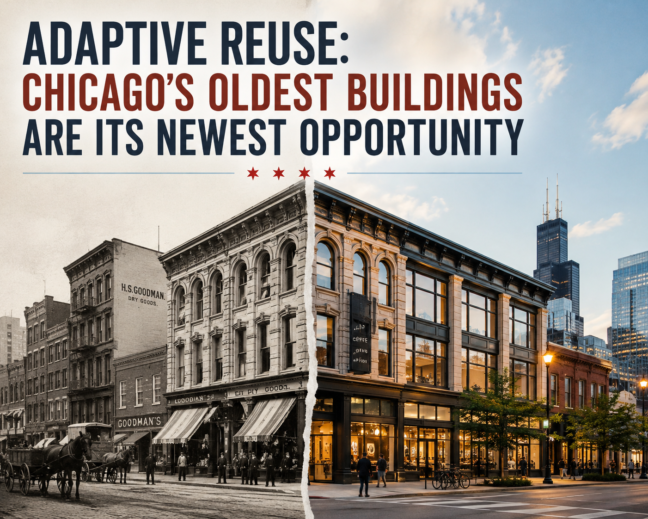
Chicago is a city built on reinvention, and no trend captures that spirit better than adaptive reuse — the practice of transforming obsolete buildings into productive new uses. Across the city, former warehouses are becoming apartments, old office towers are turning residential, industrial relics are reborn as hotels, schools, and cultural venues. What was once a niche preservation strategy has become one of the most dynamic segments of Chicago real estate.
The drivers are converging from every direction. Construction costs for new buildings have soared, making existing structures relatively more attractive. Sustainability mandates and corporate ESG goals favor renovation over demolition. Zoning reforms and tax incentives increasingly support conversions. And perhaps most importantly, the market has discovered that people genuinely prefer buildings with character — the exposed brick, the high ceilings, the sense of history — over anonymous new construction.
## Why Tear Down When You Can Transform
The economic case for adaptive reuse starts with a simple observation: the most expensive part of a building is often the part that’s already there. Foundations, structural frames, and building envelopes represent enormous embodied cost and carbon. Demolishing them to build anew means paying twice — once to destroy, once to replace.
In Chicago, where the building stock includes generations of well-constructed masonry, timber, and early steel-frame buildings, the raw material for reuse is exceptional. The city’s warehouses were built to carry heavy loads; its early skyscrapers were engineered with a solidity rarely matched today. These aren’t fragile antiques — they’re overbuilt assets waiting for a second act.
“Every obsolete building in Chicago is a question,” says Hirsh Mohindra. “The old answer was demolition. The new answer starts by asking what the structure wants to be — and the economics of that question have never been better.”
The Economics Pencil Out
Skeptics of adaptive reuse raise legitimate concerns: conversions are complex, surprises lurk behind old walls, and historic preservation requirements can add cost and delay. All true. But the comparison that matters isn’t conversion versus a frictionless new build — it’s conversion versus new construction in today’s actual market, with today’s land prices, construction costs, labor shortages, and entitlement timelines.
On that basis, reuse frequently wins. Acquisition costs for obsolete buildings reflect their distressed status. The entitlement path for renovation is typically faster and less politically fraught than new development — neighbors rarely protest saving a landmark. And the finished product commands a premium: tenants and buyers pay more for authentic character than for generic new space, whether it’s a loft apartment, a creative office, or a boutique hotel.
Financing has caught up to the opportunity. Historic tax credits, both federal and state, can offset a meaningful share of qualified rehabilitation costs. New Markets Tax Credits apply in qualifying census tracts. And an increasing number of lenders and equity investors specialize in conversion projects, bringing experience that de-risks execution.
“The math on reuse keeps getting better while the math on new construction keeps getting harder,” says Hirsh Mohindra. “Every year that construction costs rise faster than rents, another hundred old buildings cross the line from teardown candidates to conversion opportunities.”
Preservation as Competitive Advantage
Beyond the project-level economics, adaptive reuse gives Chicago a structural competitive advantage. Cities that demolish their history end up competing on cost alone — a race to the bottom. Cities that preserve and repurpose their architectural heritage compete on character, authenticity, and quality of place — advantages that compound over time and can’t be easily replicated.
Chicago’s architectural legacy is world-renowned, from the birth of the skyscraper to the Prairie School to mid-century modernism. Every successful conversion reinforces the city’s brand as a place where history and progress coexist. That brand has tangible economic value: it attracts tourists, it helps employers recruit, and it supports the premium pricing of the city’s most desirable districts.
The alternative — the demolition-driven development pattern of the mid-20th century — is a cautionary tale Chicago knows well. The city lost irreplaceable buildings to parking lots and never recovered the value. Today’s reuse movement is, in part, a correction of that mistake.
Case Study: The Warehouse-to-Residential Wave
The most visible adaptive reuse story in modern Chicago is the conversion of industrial warehouses to residential use, particularly on the Near West Side and in the West Loop. Beginning decades ago with pioneering loft conversions and accelerating as the neighborhoods around them transformed, these projects turned functionally obsolete manufacturing buildings into some of the city’s most desirable housing.
The pattern is instructive. The buildings offered what new construction couldn’t: soaring ceilings, massive windows, open floor plates, and authentic industrial character. Early converters bought at industrial prices and sold at residential premiums. As the neighborhoods matured — restaurants, transit improvements, corporate relocations — values compounded further.
Now the same logic is being applied to the next building type: the aging office tower. Chicago’s Loop contains millions of square feet of functionally obsolete office space with small floor plates that happen to be ideal for residential conversion. The projects underway today — converting mid-century office buildings to apartments — follow the warehouse playbook: buy distress, add housing where the city needs it, and let the character of the building do the marketing. Early results suggest the demand is deep, particularly for well-located units near transit.
The Playbook for the Next Decade
For investors, developers, and policymakers, adaptive reuse will only grow in importance. Several principles will separate the winners. First, move quickly on well-located obsolescence — the best conversion candidates get bid up fast once the thesis is obvious. Second, underwrite the complexity honestly; the projects that fail do so because someone underestimated structural, environmental, or entitlement challenges. Third, design for the building’s strengths rather than fighting them; the most successful conversions feel inevitable, as if the building was always meant to be what it became.
“Chicago’s future isn’t going to be built from scratch,” says Hirsh Mohindra. “It’s going to be built from what’s already here — the warehouses, the office towers, the industrial bones of the greatest building stock in the Midwest. The developers who see old buildings as inventory, not obstacles, will own the next decade.”
For a city that has always reinvented itself, adaptive reuse isn’t nostalgia. It’s the most Chicago thing imaginable: taking what exists, seeing what it could become, and building the future out of the materials of the past.